Wednesday, August 28, 2013

Helpful Freebies for Back-to-School!

This first week of school has been c-r-a-z-y busy! I can't believe we are three days into the year. On one hand, I feel like just yesterday we started but on the other hand, I feel like summer never happened!

We've spent the week catching up and completing maintenence checks on skills. Establishing routines has also been a huge this week. It's amazing how a group of kiddos can forget how to walk in a line in the hallway! So, tonight, I have a short and simple post to help you get your kiddos back on their feet.

First, assessing a student's ability to trace letters and numbers is an important precursor to writing. Check your kiddos' fine motor abilities with this Letter and Number Tracing Freebie:


This FREE resource contains a KG trace font for numbers 0-9 and uppercase and lowercase A-Z. Get more KG fonts here!


Or use this Bathroom Task Analysis Freebie (available for boys or girls!) to guide a learner's independence for toileting:


Thanks to Graphics from the Pond for the amazing, free fuzzy bumps borders!


That's all for now!


Happy Teaching!
Kortnie C.

Thursday, August 22, 2013

Throw Back Thursday: Shopping Unit Flash Freebie!

Throughout each year, we take trips for the purpose of C.B.I., or community-based instruction. These days are often a chance for our class to go somewhere in the community and practice academic and life skills. Although skills such as shopping and ordering off a menu seem to be second nature to us, individuals with autism benefit most when these skills are learned via direct instruction, using specific and explicit techniques.

Popular places for C.B.I. include restaurants, community parks, and the zoo but we typically start out by visiting a store. When planning our trip to visit a store for the first time, we acknowledged the importance of our students practicing this skill first in the classroom. We set up a "store" of empty food containers on some bookshelves in our classroom. Price tags were printed and affixed to each item and each student was given a "shopping list" of items to find. Differentiating (or leveling) this instruction was also pretty easy! Some of our students used a picture shopping list with a place for the student to check off "buying" an item. Other students used shopping lists with the check-format but also a space to write and total the price! We made it as realistic as possible, with one staff member reminding them to walk and use a quiet mouth.

Advanced Shopping List

Skill Sheet

Basic Shopping List


After a few days of prep, we visited a local store! Each student used a list to find necessary items and we later used the supplies to make pancakes (find my breakfast task analyses here). The shopping trip is one I am excited to repeat soon!

As my first Throwback Thursday, I am also making these resource a FLASH FREEBIE! Get this resource for FREE in my TpT store from 8:00 P.M. to 9:00 P.M. tonight only! Find it fast here!

Happy Teaching!
Kortnie C.

Wednesday, August 21, 2013

Mathematic Manipulative Mat Super Pack!

Whew! After another day in the classroom, things are finally shaping up! I'm (almost) done organizing the room for the 2013-2014 year and we are beginning to solidify plans for our first week! I really wish we had "before" and "after" pictures but oh, well.

This year, we would like to try to incorporate a new concept into our schedule that involves the students learning independently. During this, they will practice current and old skills in a structured, independent way for approximately 10-15 minutes. We realize it will initially take loads of prompting and then a good amount of fading, after that, but it is important that our students are able to independently attend to a task.

One of the activities we plan on using during this time involves the ever-popular counting bear manipulatives. In case you aren't familiar, they are available for purchase online, including Amazon.


We like these bears because they come in three sizes and six different colors! Really, the possibilities are endless but I have a good place to start for anyone who is interested in using these at school, home, or wherever!

Jenna, the other teacher in the classroom, created a set of brilliantly useful manipulative mats for reinforcing skills such as categorization by color, patterning, fill-in patterning, and one-to-one correspondence (#1-20). The colors red, orange, yellow, green, blue, and purple are included in the mat packet as well as blank templates for new ideas!


One:One Correspondence

Fill-In Patterning

Patterning

Categorization by Color

Fill-In Patterning Template


Above is just a quick peek at the complete 96-page document, available here in Jenna's TpT store. Be sure to follow her when you stop by!

These mats can be used with any sort of manipulative with distinguishable colors... beads, stickers, crayons, oh, my! I know I can't wait to incorporate these into our classroom and get our kiddos working independently!


Happy Teaching!
Kortnie C.

Monday, August 19, 2013

Token Board Starter Pack (Dinosaur, Princess, Train, and Rainbow Token Boards)

With school just around the corner (six days away!), we are starting to finish arranging the classroom and beginning to build things for individual students. Like what, you ask? Well, I'll reference a quote I've heard: "If you know one individual with autism... you know one individual with autism."

A common way to manage behaviors is through a token economy. Token economies can be as simple or elaborate as the child for which they are designed. Some adults discredit them initially without realizing they are subject to one on the daily... money! In other words, money (a token) is earned (most likely through task completion at work) to access reinforcers (i.e. food, clothes, electricity). Trust me on this one, they can get much more difficult than that; the good news is, though, they don't have to! Even basic token economies hold much scientific merit.

Basic components of a token economy:
1. Tokens (tickets, pennies, small picture cards... keep in mind these do not necessarily need to be "appealing" the the child but instead serve the purpose of telling him/her that reinforcement is ## responses away)
2. [Withheld] Reinforcers (this is different for each individual but may often include food, verbal praise, or a preferred activity)
3. A well defined target behavior (a.k.a. behavior to increase, TB)

That's it! Of course, for our visual kiddos with autism, we typically include an actual base or board, pictures or symbols of available reinforcers, and a space on the board for the currently selected reinforcer. Sometimes even a timer is helpful.

Basic guidelines for a token economy:
1. Start off with the student set up for success (by allowing the student to contact the reinforcer or "prize" )
2. Be consistent (this is easily done if your behavior to increase is very well defined and yes, across staff members)
3. Offer multiple reinforcers across functions
4. Gradually increase what is "expected" (the response requirement)

Further information is readily available from Cooper, Heron, and Heward's publication of Applied Behavior Analysis. Which leaves me with the fun part: actually making the token economies! We tend to design our kiddos' with a little personal flare. An FR5 (fixed ratio of five... the number of tokens required to "cash in" for a reinforcer) is pretty standard in our classroom but your ratio of tokens/per reinforcer will depend on the child in mind. With this in mind, I made a token boards today that will debut in our classroom this year!


Grab your copy here:
(while the last few hours of the TpT sale take place!)


Happy Teaching!
Kortnie C.

Saturday, August 17, 2013

I Spy Colors: An Adapted Book

In less than two weeks, our kiddos will be back to school. During those initial days, we plan on assessing the students to see how well their skills maintained over the summer (or, if the student is new, we will assess to determine what skills they currently hold). A popular skill program in our K-2 classroom is learning colors. We tend to teach the necessities (red, yellow, blue) as well as extra colors (purple, green, orange, black, etc.).

To compliment our traditional direct instruction, I like to create a resources to help practice common skills. Adapted books are one of my favorite methods (if you couldn't already tell) of doing this. So, today I authored I Spy Colors


I Spy Colors is designed to increase expressive and receptive language. It targets skills such as naming pictures of objects and colors.

Differentiation (or leveled, individualized) instruction is a built-in feature, too! For example, a teacher may read with the student and then prompt, "Find red." The student could point to the red items on the page or the teacher may require the students to name the red items by saying "firetruck" and "apple." A more advanced student, however, may read independently or with the help of the pictures above the text.

I think this book will prove to be a great resource. Hopefully I can make a few more of these before school starts!

To my parent readers out there: Books like this can be great resources for connecting with your child at home. We often take adapted books on our C.B.I. (community based instruction) trips for the students while they are waiting or on the bus. Remember, your child's learning starts with you!


Get your own copy of this resource here, in my Teachers Pay Teachers store.

This resource and all others will be sold at a reduced price from August 18th-19th for the Teachers Pay Teachers back-to-school sale! Load up your cart for this great savings event!


Also, here's a quick peek at another adapted book I finished today. Do you recognize it?


Happy Teaching!
Kortnie C.

Friday, August 16, 2013

A Tool for Tallying Frequency

Because our classroom utilizes an ABA-based model, the staff and teachers in the room our almost constantly taking data on one or more students (and often multiple behaviors for each kiddo!). We use this data to drive our instruction and decision making. Frequency is a common way to measure how many times a behavior occurs. It's a useful measure for "quick" behaviors (such as vocal outbursts or addition problems completed).

Today's post is probably a regular tool for many, but I've come to realize there are tons of parents and teachers who aren't aware of a device for counting frequency: the tally counter!


This tool can be purchased from Amazon or at most sports stores. They're notably inexpensive ($1-4) and typically come with a black lanyard for use. With the lanyard, the tally counters can be clipped on a key ring, belt loop, or worn as a necklace. At the end of a day, session, time period, or interval the number on the face of the tally counter can be transferred to the data sheet.

Additional colored lanyards (shown above) can be purchased, too; this is helpful in situations for tracking multiple behaviors or multiple students.

I prefer tally counters because they are a tool that is inexpensive and reliable. They don't use batteries and, when worn, travel constantly with the individual collecting data. Tally counters may also prevent some errors in data for those moments when you're thinking, "Oh, I'll remember to write that incidence [of behavior] down." (Come on, we've all done it at least once.) In addition to all of this good stuff, they're nearly indestructible.


Happy Teaching!
Kortnie C.

Tuesday, August 13, 2013

4 DIY Fine Motor Tasks


As I've mentioned, I spent six weeks of my summer as a lead teacher in an academic-based program for inner city youth. My class consisted of a group of wonderful kiddos entering Kindergarten this fall. To help them prepare for the usuals of Kindergarten (cutting with scissors, writing with a pencil), I created a series of fine motor tasks for use at our "choice table." The choice table was a special table where students could select an activity for 15 minutes at the start and end of each day. In addition to my homemade fine motor tasks, the table held puzzles, books, and other rotated materials.

Fine motor movements involve small muscles, specifically in the hands, feet, and mouth. Students, especially young children and individuals with autism, can benefit from extended practice using these. As the muscles develop or strengthen, activities such as writing with a pencil and feeding with a spoon usually become much easier. In fact, fine motor tasks often use and develop other skills such as hand-eye coordination or even gross (large) motor skills.

The fine motor tasks were designed to be quick and inexpensive. I hope your students enjoy them as much as mine! (Note: Even though I created these for my regular ed class this summer, I plan on using them in our AS classroom, for sure!)


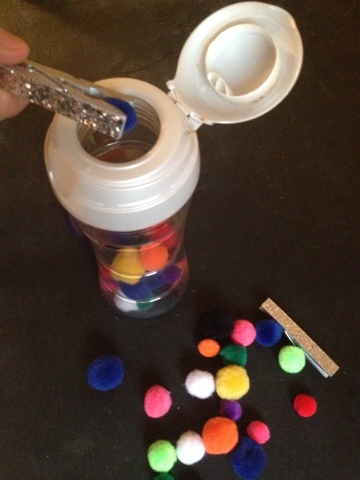
Pom-Pom Bottle:

Materials: 
pom poms (small, medium, and large)
Fabric Softener bottle
1-4 clothespins

Objective: Students use the pincher grip (thumb and pointer finger) to use clothespins to pick up pom-pons and place them in the opening in the top of the bottle. When finished, store all materials inside the bottle!


Pipe Cleaner Piggy Bank:

Materials:
pipe cleaners
bank with slit in lid or a bottle with a slit cut in the lid

Objective: Students use the muscles of the hand to maneuver pipe cleaners into the thin slit on the top of a bank. When finished, store pipe cleaners inside the bottle.


Cover the Numbers:

Materials
small pom poms
markers
number cards, cut, colored, and laminated (Found Here)
pencil case

Objective: Students use the pincher-grip to place the correct color of pom pom on each dot of a number card. Numbers 1-10 are included using dots commonly used in math programs. When finished, store materials in a pencil case or container.


Magnetic Wand Bottles:

Materials:
pipe cleaners, cut into pieces
magnets or magnet wands
empty see-through bottles
hot or super glue for sealing bottles

Objective: Students use magnets or magnetic wands to manipulate the pipe cleaner bits inside the plastic bottle. May be used as a scientific method for increasing hand-eye coordination.


These tasks allow students to develop fine motor muscles in an engaging way. Once teaching students proper use, they quickly gain independence. Plus, if more than one student is working with a specific task, opportunities for taking turns and cooperative play are available. Which fine motor work task would be a win with your kiddos?


Happy Teaching!
Kortnie C.